The Beijing-Shanghai quantum backbone network, the world's first secure quantum communication backbone network, will go fully operational later this year. The 2,000-kmlong quantum backbone is a stretch of high-quality optical fiber that boasts high-security features to prevent hacking and enable the secure passage of information.
The network will be mainly completed by scientists from the University of Science and Technology of China, which is based in Hefei, capital of East China's Anhui province. The control center for the network will be at USTC's Institute of Advanced Technology.
 |
|
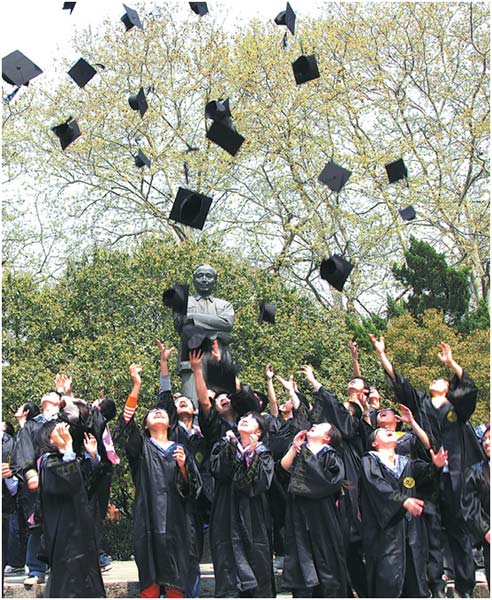
Students celebrate their graduationin front of the sculpture of Guo Moruo, the first president of USTC.YANG XIAO PING / FOR CHINA DAILY |
The IAT was jointly founded by the Anhui provincial government, the Chinese Academy of Sciences, the Hefei municipal government and USTC in 2012, in order to power local economic growth and foster the university's creativity in breeding high-tech enterprises.
"Traditionally, scholars at Chinese universities focus intensively on academic research but care little about transferring the results of their studies into commercial use," said Li Weiping, deputy chief engineer at IAT.
According to Li, until recently, very few of USTC's research projects produced end-products that were used commercially and only a small number of its researchers started their own businesses. The USTC is one of the country's top universities renowned for fundamental sciences, while the IAT aims to provide local industries with more skilled graduates which will, in turn, attract more high-tech companies to Hefei. Part of the university's emphasis is on attracting high-caliber professionals from overseas.
Li Weiping, a Stanford PhD graduate and former professor at the US-based Lehigh University, is a listed expert in the nation's Thousand Talents Plan, which is designed to attract high-caliber foreign professionals.
"University researchers need highly efficient institutions to help them transfer viable technologies into commercial use", said Li, adding that IAT is now making fundamental changes to ensure researchers have all the support they need to produce commercially viable end products.
Zhang Jie, chairman of the US-based GeoTomo LLC, an international earth imaging solutions provider, agrees, and also feels that students should take a hands-on approach to learning.
Zhang, who is a professor at IAT, and his colleagues co-founded Hefei GeoTomo Technology Co and Anhui GeoTomo Electronic at the institute. Zhang allowed some of his most talented students to take full charge of daily operations at the two firms in the hope that they will become both researchers and entrepreneurs.
Both students and professors at IAT are given the opportunity to become entrepreneurs, and as well as their regular courses, which are largely engineering-oriented, students are also taught how to start and run high-tech companies.
 |
|
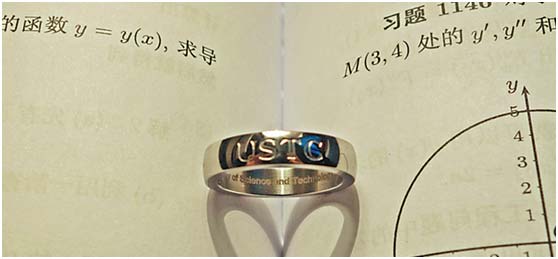
The university gives each graduate a ring caved with the letters USTC. YAO QIONG / FOR CHINADAILY |
Li said IAT is not only a research institute but also a high-tech park that offers a base for a number of tech firms. He revealed that Stanford Research Park had provided the inspiration for the establishment of IAT.
"The Stanford Research Park has served as a role model for a lot of other high-tech parks worldwide, and IAT is one of them," he said.
By the end of last year, IAT was already home to 136 high-tech firms — most of which were founded by USTC professors and students.
It also has 36 laboratories established by the university and several globally renowned companies including Microsoft, Intel and Alibaba.
Contact the writer at zhulixin@chinadaily.com.cn
China Daily USA, 2016-09-30, Source: http://usa.chinadaily.com.cn/epaper/2016-09/30/content_27108249.htm
